
Vegetable gardening
How Much Compost Does a Raised Bed Need?
A raised bed’s full volume and its next compost addition are different calculations. Decide whether you are filling an empty frame or improving existing soil before measuring how much material to carry outside.
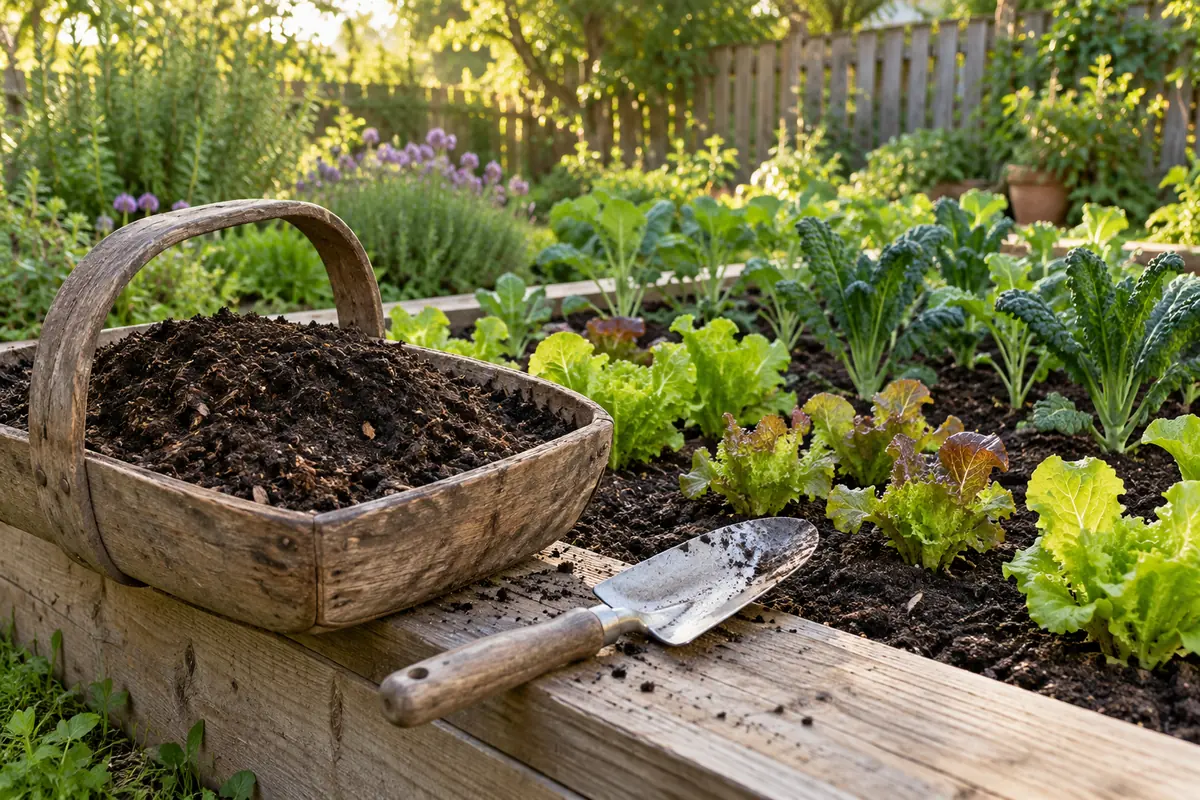
Separate filling a new bed from amending an old one
An empty frame needs a suitable growing mixture. Oregon State University Extension specifically advises against filling framed beds with compost alone. Its guidance for mixing excavated soil into a new bed allows up to 25% compost by volume; that is a particular method, not a required recipe for every site.
An established bed already contains soil and nutrients. Its next addition should reflect soil condition and previous inputs. Do not calculate the entire frame volume and treat that number as a compost requirement. Similarly, a soil level that has settled does not prove that the missing volume should be replaced entirely with compost.
Choose an addition using soil information
University of Minnesota Extension recommends soil testing to decide whether and how much to add. It offers about a half-inch surface layer as guidance for non-manure food-scrap or yard-waste compost in vegetable gardens, while emphasizing nutrient monitoring.
Treat an example depth as an input to evaluate, not an automatic annual prescription. A repeatedly amended bed can need a different decision from depleted native soil. Keep manure-based compost separate in your planning because it is also a nutrient source. If your report is unclear, ask the testing lab or local Extension office to interpret it for the crop and soil you have.
Calculate the volume after deciding the depth
For a rectangular area, multiply length × width × layer depth, using consistent units. With bed dimensions in feet and depth in inches:
Compost volume in cubic feet = length × width × depth ÷ 12.
For metric measurements, length in meters × width in meters × depth in centimeters × 10 gives liters. These are geometric conversions, not fertilizer recommendations. Use our raised bed soil calculator to compare full fill volume with a separately chosen compost layer.
Worked example: a 4 × 8 ft bed
A 4 × 8 ft bed filled to 12 inches holds 32 cubic feet of total growing medium. A half-inch surface addition to the same area is only 1.33 cubic feet, approximately 38 liters. A one-inch addition is 2.67 cubic feet, approximately 76 liters. These examples demonstrate the calculation; they do not establish the correct layer for your bed.
If a suitable new-bed plan calls for a 25% compost share of that 32-cubic-foot volume, the mathematical share is 8 cubic feet. It is part of a soil mixture, not an extra layer added on top. Check how much compost is already present in a supplied blend before calculating any additional amount.
Record the amount you actually apply
Minnesota Extension warns that excessive compost, especially repeated manure-based applications, can accumulate nutrients and soluble salts. More compost is not automatically a better growing environment.
Write the bed dimensions, chosen depth, compost type and applied volume on one record. Use a container of known volume to portion material evenly, then keep the record with the soil-test result. Before application, review how to use finished compost and confirm that the material is mature rather than a batch still receiving fresh scraps.
Written for ordinary outdoor home composting. Ingredient guidance and timing can vary with your climate and setup; linked public resources provide further detail.