
Composting methods
Compost Bin vs. Tumbler: Which Fits Your Routine?
A stationary bin and a rotating tumbler organize the same basic process in different ways. Choose between them by following an ordinary week of scraps, mixing and harvesting, rather than by the shape of the container alone.
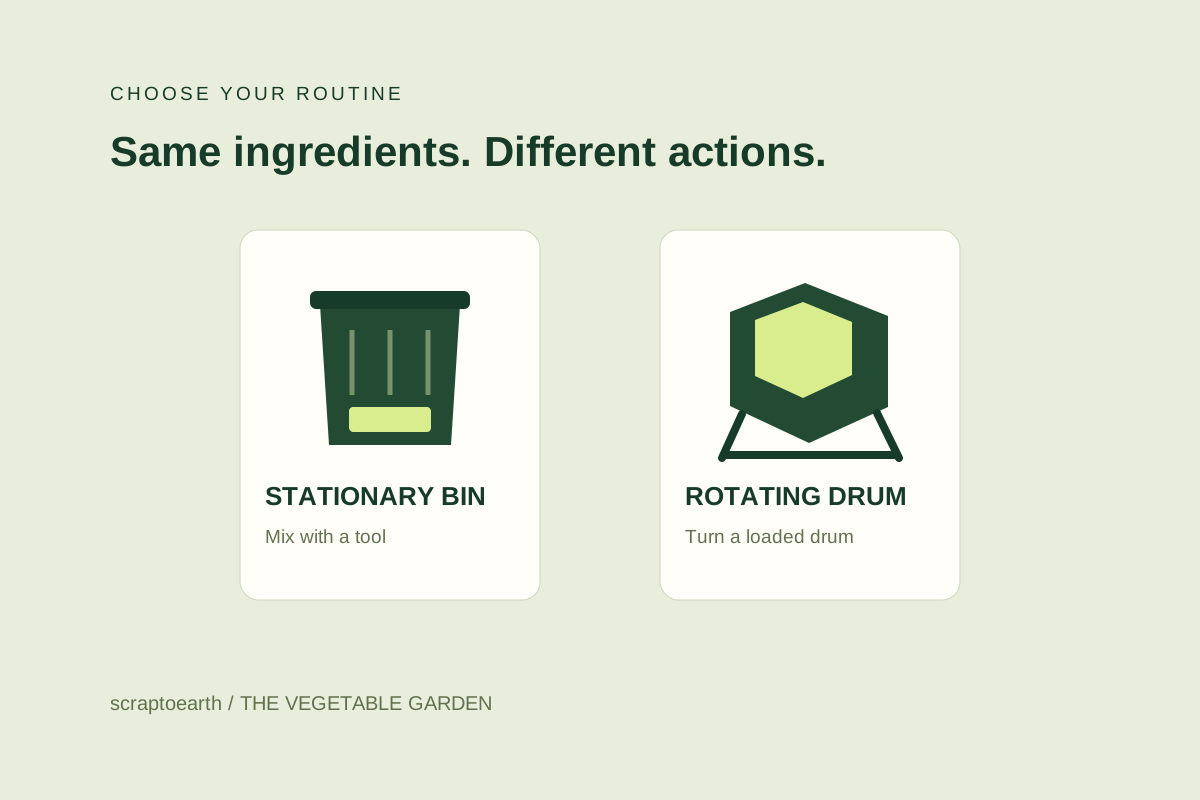
Compare the actions each system asks of you
A stationary bin stays in place while you work the contents with a tool or move material between areas. A tumbler holds material in a drum that you rotate. Both still need suitable ingredients, moisture and air.
| Task | Stationary bin | Rotating tumbler |
|---|---|---|
| Loading | Can you comfortably reach the opening? | Is the door easy to reach and close? |
| Mixing | Can your tool reach the material? | Can you rotate a loaded drum? |
| Harvesting | How will you remove a mature batch? | Where will the contents land? |
| Working space | Room for tools and access panels | Room for rotation and unloading |
Match capacity to what you actually collect
UConn Extension distinguishes compact enclosed systems from holding or multiple-bin setups better suited to large volumes of leaves and garden debris. Record a typical week’s materials and note seasonal peaks before comparing container capacities.
Separate two questions: where the next load will go, and where the existing material will finish. If autumn cleanup produces many bags of leaves, a single small drum may not solve the storage question. If your household produces only a little material each week, a large enclosure does not automatically create a large active pile.
Plan a place for material that is finishing
Oregon State University Extension describes add-as-you-go bins and suggests separate accumulation and active-composting capacity when using tumblers. The useful distinction is the batch plan, not simply whether the container spins.
Try writing a two-line plan: “Fresh material goes here; finishing material stays there.” A divided drum may support that routine, but read the construction details before assuming its compartments provide independent mixing or easy harvesting. A second holding area can also serve a stationary system. Whatever the equipment, keep track of when fresh additions stop for the batch you intend to use.
Do not treat rotation as a completion guarantee
University of Maryland Extension’s comparison notes that tumblers can help with aeration but need close attention; loading or harvesting may be awkward, and their volume may be insufficient for hot composting. It also warns that too many wet scraps without enough browns can leave a tumbler soggy.
Ask whether the routine suits your reach, strength and available time. Inspect the mechanism and doors in the configuration you would actually use. No container shape removes the need to check what is inside. If a batch is slow, work through the breakdown checklist before changing equipment.
Choose a repeatable routine
Shortlist a stationary bin if its loading and tool access fit your materials. Shortlist a tumbler if you can operate the loaded drum comfortably and have a realistic batch plan. These are starting points for comparison, not a universal ranking.
Recheck the proposed location and keep the material checker nearby for uncertain additions. If neither setup fits the space or maintenance you can provide, it is reasonable to investigate local food-scrap collection instead.
Written for ordinary outdoor home composting. Ingredient guidance and timing can vary with your climate and setup; linked public resources provide further detail.